The Big Apple: five boroughs of ambition, rats and closets marketed as "cozy studios with character".
- Subject
- New York City
- Filed by
- Trumpery Times Desk, Aug 20, 2025
- Reading time
- 14 min
- Believability
- Rent-controlled
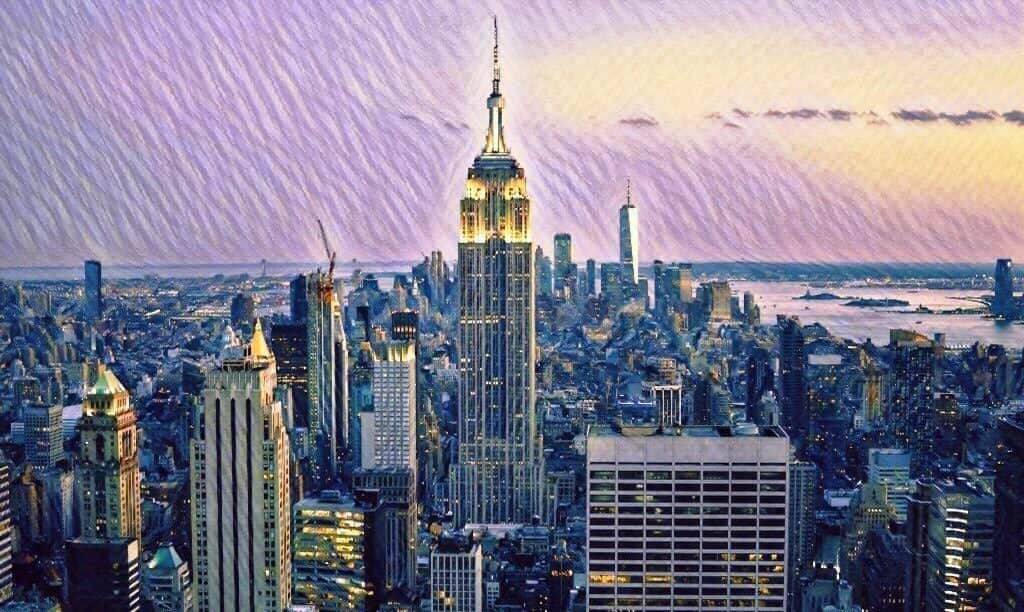
New York City 101
Salutations to New York City or as its residents respectfully whisper with a reverence normally reserved for sacred objects, “The Big Apple.” What better captures the city’s peculiar brand of urban chic than naming a steel-grey metropolis of towering skyscrapers after something you pick up in the produce aisle?
This glittering monument to human ambition stretches majestically across five boroughs, a shimmering disaster waiting to unfold. Manhattan, Brooklyn, Queens, the Bronx, and Staten Island—each a jewel in NYC’s crown with eye-watering rents and oppressive concrete landscapes. It looks as though city planners drew up a map of the Eastern seaboard, closed their eyes, threw darts at it, and screamed, “These randomly selected patches of land will one day become mankind’s greatest city!”
Picture this vision of capitalist utopia: 8.5 million people packed into 300 square miles, creating America’s largest city. More human bodies per square inch than a Black Friday shopping frenzy only with even less humanity. Space? Who needs space when you can enjoy breathing in a stranger’s armpit on the subway while paying $5,000 a month for a cupboard realtors describe as a “cozy studio with character”?
But hold on, because there’s still more human suffering to uncover! More than 20 million people live in the wider metropolitan area, because apparently 8.5 million residents within the city itself were not quite enough of a challenge for the putrid sewer system.
The city boasts more than 800 languages spoken within its limits, earning it a reputation as one of the most linguistically diverse places on Earth. Nothing captures that diversity quite like being unable to communicate with 799 out of every 800 neighbours while packed into a subway carriage filled with trash, sweat, and whatever else the underground ecosystem decided to spew up that day. New York is not just a linguistic petri dish; it is an olfactory experiment in human endurance. Think you got what it takes?
Let’s turn to New York City’s humble beginnings, because every modern Babylon needs an appropriately grand creation myth. Dutch colonists arrived on Manhattan Island in 1624 and apparently looked around, nodded approvingly, and thought: “Yes, this will do nicely for a trading post.” They named it Fort Amsterdam a display of originality that comes with naming a new settlement after the place you came from, as though you miss it so much already.
The colony became New Amsterdam in 1626 and remained that way for 38 years, until English forces arrived in 1664 with their own vision of progress: renaming it, in an equally inventive manner, after the Duke of York. Few things capture colonial confidence quite like arriving somewhere, taking ownership, and immediately changing the signpost.
Nowadays, the heart of New York is on Wall Street, that sacrosanct shrine of capitalism where financial titans gather daily to play the most expensive game of Monopoly humanity has ever invented. The city is the kingdom of NASDAQ and the New York Stock Exchange, and apparently one gigantic financial casino wasn’t enough. Its champions have proclaimed New York “the world’s premier financial center” and “the most economically powerful city on Earth,” boasting a gross metropolitan product of over $2.16 trillion a year. That’s far greater than the GDP of a lot of countries put together! Surely such wealth has solved all the city’s problems and created urban paradise, right? Right? After all, Americans are famous for their generosity of spirit and love for their fellow man.
Well, barely. With its 24/7 rapid transit system (because nothing says “rapid” quite like waiting 20 minutes for a delayed subway carriage filled with broken dreams and equally broken humans), New York also holds the dubious honour of having some of the worst traffic congestion on Earth. Who could have predicted that squeezing millions of people and vehicles into a small space might create problems?
It even earned the title of the world’s most expensive city for expats in 2025. Fifth Avenue remains the most expensive shopping street on the planet, because, naturally, someone looked at luxury retail prices and thought, “Yes, this city should also be able to sell a $50 designer hot dog while pretending to be financially responsible.”
More ultra-high-net-worth individuals, billionaires, and millionaires live in New York than anywhere else on Earth. Meanwhile, working people are often just about able to afford tiny studios that function less like apartments and more like luxury prison cells, just with better branding. At least they get to live close to wealth they will probably never touch, benefit from, or see outside a newspaper headline.
The city’s summer season deserves special recognition for transforming Manhattan into an olfactory obstacle course. Rubbish baking on pavements, exhaust fumes mixing with suffocating humidity, and the unmistakable aroma of evaporating urine drifting from subterranean subways combine into an assault on the senses guaranteed to haunt tourists forever. It is less a city and more a giant terrarium of human waste, crushed ambition, and the tears of graduates discovering their $200,000 degree qualifies them for an unpaid internship. Unless your daddy happens to work here, of course.
That’s New York City for you—all glorious chaos. The city that never sleeps, largely because noise pollution prevents it and rent forces everyone to work three jobs just to remain technically (but not spiritually) alive. It’s the greatest city on Earth—if by “great” you mean surrendering your sense of smell alongside 8.5 million exhausted souls who insist this is somehow the peak of human civilization’s achievement.
So cheers to New York City: where dreams arrive, receive a bill, and slowly collapse under the weight of their own expenses. A place where everyone is too busy to appreciate the extraordinary privilege of living inside the most expensive illusion of success ever created.
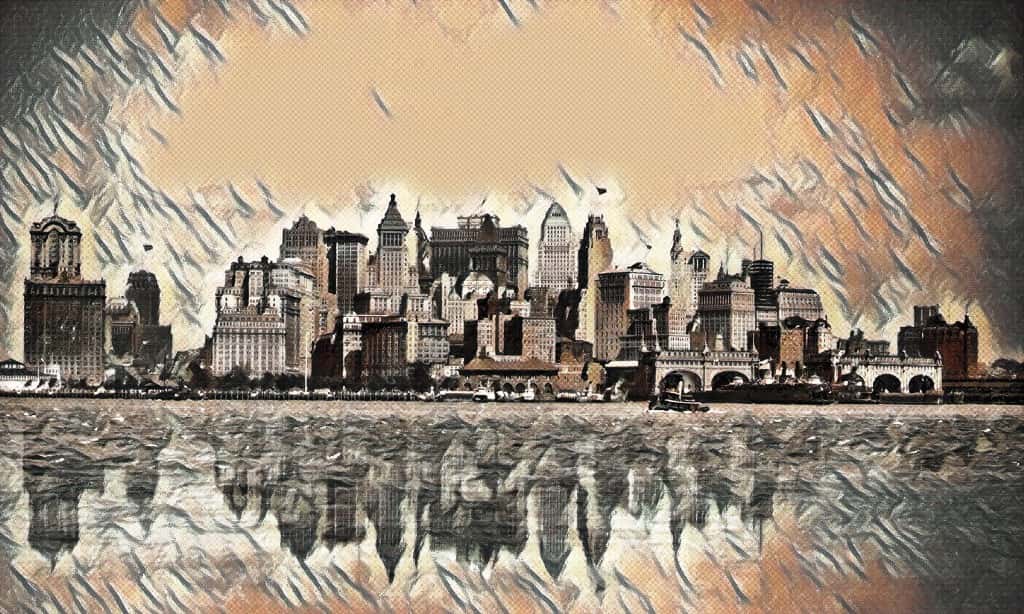
A Brief History of The Big Apple
Take this scenario: the most valuable slice of real estate on the planet began life as a mosquito-infested swamp. That is the origin story of New York City—a beginning so absurd that even a satirist might reject it as being too far-fetched.
Long before anyone imagined squeezing 8 million people onto a tiny island, there were peaceful communities known as the Lenape. No $15 sandwiches. No subway rage. No overpriced bodegas. Just a functioning society enjoying the land before Europeans arrived with maps, diseases, misplaced confidence, and the firm, mistaken belief that you could discover somewhere that had already been discovered.
Giovanni da Verrazzano sailed into New York Harbor in 1524, looked around, and promptly declared the entire area French territory. Because apparently the most convincing method of establishing ownership is arriving in a new land completely uninvited and planting your foreign flag. Spanish navigator Estêvão Gomes followed in 1525, giving the Hudson River the dramatic title of “Rio de San Antonio.” Then Henry Hudson arrived in 1609 searching for Asia, demonstrated the finest traditions of historical navigation by not finding Asia at all, and claimed the area for the Dutch. By this point, the land had been “claimed” about as many times as a prime Midtown parking spot.
The Dutch officially founded New Amsterdam in 1624, displaying their legendary creativity by naming their New World colony… New Amsterdam. Revolutionary stuff. Then came perhaps the most outrageous real-estate deal in history: Peter Minuit supposedly purchased Manhattan for 60 gilders around $900 in today’s money. The same island where a studio apartment now costs $5,000 a month was once acquired for less than the price of a decent night out. Modern real-estate agents have been quietly weeping ever since.
Director-General Peter Stuyvesant took control in 1647 and became something of colonial New York’s first chief killjoy. He regulated alcohol sales, enforced strict religious rules, and generally drained the joy from people’s daily lives. In a city that would later turn brunch into a cultural institution, this was practically an act of war.
Then came the English in 1664, politely informing Stuyvesant that he should possibly consider surrendering without a fight, there’s a good chap. He eventually did so without much resistance, perhaps exhausted from governing what was still essentially an ambitious swampland. The people might even be pleased to get a little fun back in their lives. The English renamed the colonial settlement New York after the Duke of York, presumably deciding that “New Amsterdam” lacked sufficient imperial branding. The Dutch briefly reclaimed the city in 1673 and renamed it New Orange, because nothing says historical stability quite like changing a city’s name every few years. And sadly, ‘Orange is the New Amsterdam’ didn’t quite cut it for Netflix. The Dutch eventually returned it to England in 1674, mercifully saving future tourism boards from explaining why their destination was named after a citrus fruit – a fact that Florida would take full advantage of centuries later.
By 1730, New York had become a major centre of the slave trade, with enslaved Africans forming a significant part of the city’s population and economy. The multicultural metropolis celebrated today was built alongside a brutal system of exploitation. The later discovery of the African Burial Ground, containing thousands of colonial remains, served as a reminder that beneath the skyline and endless reinvention lies a much darker history.
During the Revolution, New York managed to play both sides at once, like Clint Eastwood in Fistful of Dollars—the perfect early demonstration of the political flexibility that would define the city for centuries. After the Continental Army’s defeat at Long Island, British forces took control, and New York became a Loyalist stronghold. Even then, the city seemed to understand the importance of backing the side most likely to win, to ensure it too came out on top..
Following the Revolution, New York enjoyed a brief but celebrated stint as the nation’s capital. Washington was inaugurated here, Congress met here, and the Bill of Rights was drafted here. Naturally, New Yorkers have never allowed anyone to forget this, even after the capital moved elsewhere twice. It’s the historical equivalent of boasting about being valedictorian of summer school—technically impressive, but missing some important context.
The 19th century transformed New York from a growing port into a global giant, with its population exploding from around 60,000 to millions thanks to immigration. Refugees from the Irish famine discovered what generations of newcomers would learn: New York was expensive, crowded, and absolutely convinced of its own greatness. Not just the Big Apple, but the biggest apple. Meanwhile, the Erie Canal turned the city into a commercial powerhouse in 1825, while political corruption reached something approaching an art form under Tammany Hall.
The Civil War exposed the city’s complicated relationship with power and privilege. Mayor Fernando Wood suggested that New York should secede from the Union—a level of confidence that bordered on arrogance that only New York could deliver with a straight face. And then came the Draft Riots of 1863, when anger over conscription exploded into some of the worst urban violence in American history, including horrific attacks against Black New Yorkers. More than 100 people died, revealing a city capable of extraordinary ambition and extraordinary cruelty in equal measure
The late 19th century brought New York’s grandest era of self-confidence. The Statue of Liberty arrived in 1886, a gift from France to a nation already skilled at reinvention. Ellis Island welcomed millions of immigrants chasing opportunity, only to eventually discover the joyous reality of New York’s rental market. Brooklyn was consolidated into the modern city in 1898, creating the five-borough metropolis we know today. Later came the New York subway system, which opened in 1904, introducing residents to one of New York’s oldest and least-loved traditions: standing in a stranger’s eyeline, inches from their nose while pretending they don’t exist.
The 20th century cemented New York’s reputation as a global capital of ambition and ego. By the 1920s, it had overtaken London as the world’s largest city. The Great Depression briefly humbled its residents, but World War II restored the city’s confidence. The United Nations headquarters opened in 1952, because apparently the ideal location for global diplomacy was the most expensive, overcrowded, high-strung city on Earth.
And so we arrive at the great New York transformation: a mosquito-filled island becoming the self-proclaimed “Greatest City on Earth.” From acquiring the entire fetid landmass for $900 to $5,000 shoebox apartments, from Dutch merchants to Wall Street’s masters of the universe, New York has remained remarkably consistent—sky-high prices, relentless crowds, and enough self-confidence to power a small nation.
The truly impressive part? After centuries of questionable decisions, impossible costs, and enough collective ego to fill several quarries, people still keep arriving. Perhaps New York’s greatest achievement is convincing millions that paying $15 for a sandwich and living in a converted cupboard is not a punishment, but a privilege worth paying for. That may just be the greatest marketing trick ever conceived.
The Five Boroughs: A Guidebook to the Great Dysfunctional City of New York
New York City—the Big Apple, the City That Never Sleeps, the city in which dreams are priced in dollars and nightmares are credit card debt that could fund an African coup. It’s essentially five boroughs stitched together into one sprawling civic experiment, each convinced it’s carrying the other four. Imagine five flatmates locked into a lease so eye-wateringly expensive that moving out simply isn’t an option. Let me introduce you to them all.
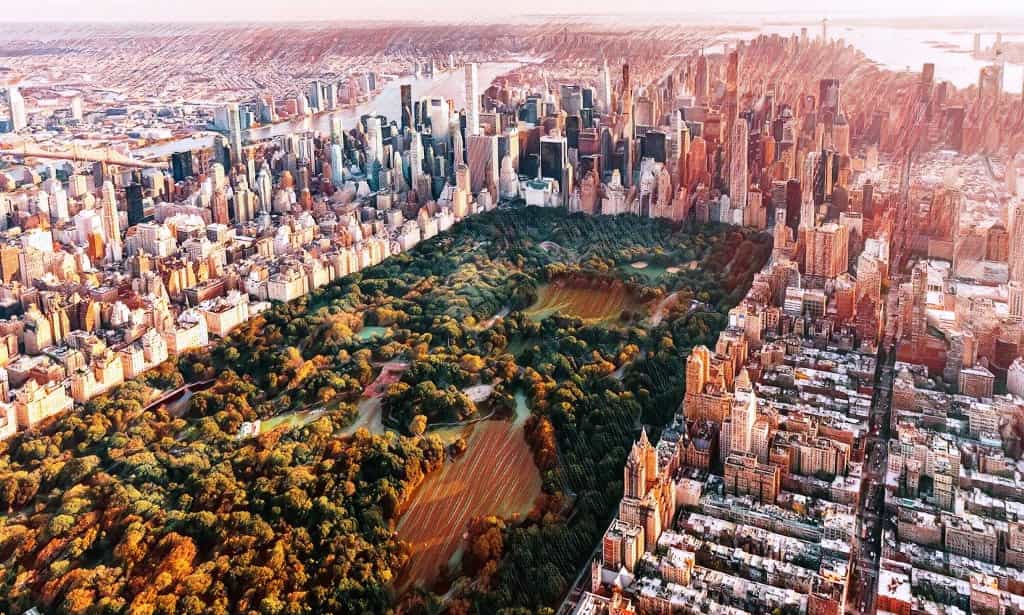
Manhattan: The Overachieving Golden Child
Manhattan’s the Harvard grad borough who knows money talks and bullshit walks. Manhattan turns a visit to Starbucks into a hostile takeover – it’s all business to Manhattan. Born and raised New Yorkers call it, in hushed and almost reverential tones, “The City,” as though the other four boroughs were merely oversized parking lots with delusions of grandeur.
This tiny island crams in around 70,450 people per square mile—not just exhausted commuters squeezed onto train carriages every morning, but living, breathing human beings in designer suits who make more money in a year than many people will see in a lifetime. Then there’s Central Park, the great green rectangle where New Yorkers can briefly pretend nature still exists while wandering past finance bros having existential crises and pouring their hearts out to ducks.
Its skyscrapers reach toward the heavens like architectural middle fingers, housing multinational corporations that probably have your data, your credit score, and possibly your first-born child. Wall Street operates in the shadows like an economic vampire, draining resources from global markets while somehow convincing everyone it’s performing a vital public service. Meanwhile, the United Nations headquarters sits nearby, because nothing says “world peace” quite like asking diplomats to navigate one of the most expensive, chaotic cities on Earth while paying $25 for a sandwich that would cost $3 anywhere else.
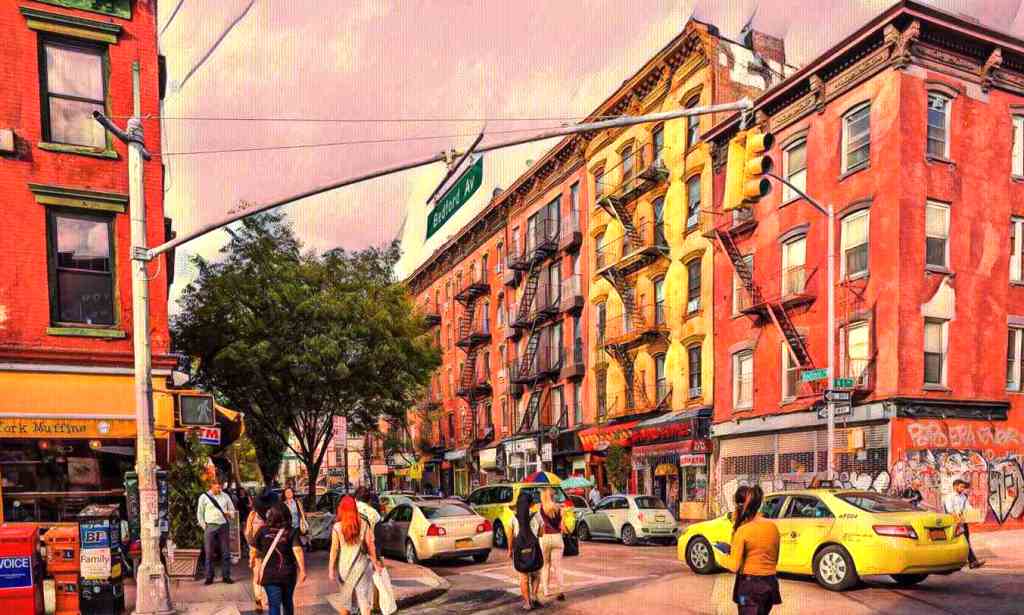
Brooklyn: The Hipster Who Discovered Capitalism
Brooklyn was transformed from gritty outsider to global symbol of gentrification faster than you can say “vintage furniture artisanal pickle store.” It’s like your eccentric aunt suddenly inheriting a fortune in cryptocurrency: exciting, impressive, but also highly suspicious and impossible to sustain.
The borough now contains more people than some whole countries, many of whom proudly insist they were there “before it was cool”—whether that was yesterday or during the Carter administration. Coney Island, America’s first major amusement park, has been entertaining visitors since 1870, offering the timeless combination of nostalgia, cotton candy, and the existential terror of riding rollercoasters that were built long before health and safety regulations.
Fort Hamilton remains the city’s only active Army installation, dating back to 1825. Its continued presence is perhaps one of the few places in Brooklyn where property prices have not completely spiralled out of control, because the U.S. government has yet to discover the joys of converting military bases into luxury flats with artisanal coffee downstairs.
Downtown Brooklyn continues its mission to become a serious business district, which is admirable in the same way that a talented understudy deserves applause despite the fact that everyone is still waiting for the real star of the show. Manhattan remains the dominant sibling—the overachieving older brother who takes over the entire family conversation. Brooklyn may be impressive, but it has a lot of growing up to do.
Queens: The World’s Least Organized Cultural Experiment
Queens is the world’s most culturally diverse place outside of a United Nations convention, a global food festival disguised as a borough. Walking through Queens is like channel-surfing foreign TV in a hotel room, except the remote flicks between channels in dozens of languages and every neighbourhood has its own unique celebrations, cuisine, and identity.
It’s home to the US Open, where the wealthy politely launch fuzzy yellow balls at each other while even wealthier people watch from luxury box seats and somehow convince themselves a $15 pretzel is fine dining. The New York Mets play at Citi Field, which feels appropriate because in Queens, baseball dreams are often born, tested, and occasionally sent to electroshock therapy.
Queens is also home to both JFK and LaGuardia airports, meaning millions of visitors receive their first taste of the Big Apple here: “Why is everything so expensive, and why does this taxi smell like air freshener fighting a losing battle with despair?”
The Bronx: Culture Beyond Commerce
The Bronx holds the unusual distinction of being New York’s only borough located entirely on the mainland, making it the geographical outsider of the family. It’s also the birthplace of hip-hop, proving that revolutionary art can emerge from anywhere even somewhere whose other major attraction is watching grown men in pajamas swing truncheons at balls while you drink $50 beers.
Yankee Stadium dominates the skyline like a monument to sport’s worst capitalist excesses: seats you’d need a mortgage to buy, and gas station hot dogs sold at Michelin prices. The Bronx Zoo, meanwhile, stretches across 265 acres and is home to more than 6,000 animals roughly the population of a Manhattan apartment block, except the animals have considerably more space and don’t have to pay rent.
The borough is also home to Co-op City, America’s largest cooperative housing development. It sounds idyllic until you discover that the 50,000 residents must vote on major decisions affecting the place they call home. It’s essentially democratized apartment living: imagine needing a committee meeting before deciding what color curtains you want.
Staten Island: The Suburban Stepchild
Staten Island is New York’s reluctant suburban experiment a borough that seems to have looked at the rest of the city’s boroughs and said, “Great, but let’s try that again only with fewer people screaming on the subway.”
The island connects to Brooklyn via the Verrazzano-Narrows Bridge, an expensive way of announcing: “We’re family, sure, but let’s maintain some distance, OK?” The Staten Island Ferry offers New Yorkers a free ride into Manhattan, which is perhaps the city’s greatest act of generosity and therefore immediately suspicious to its inhabitants.
The island is also home to the Staten Island Greenbelt: 2,500 acres of protected natural habitat with 28 miles of trails and one of the last remaining forests in the city. Translation: New York discovered some green space that hadn’t yet been turned into luxury apartments and immediately put them behind a fence so as to keep Mother Nature happy.
Staten Island represents the Big Apple’s closest approximation of suburban tranquillity a place so suburban that even the people of New Jersey occasionally looks over and thinks, “They’re doing pretty well for themselves.”